


The importance of mock tests for NEET students is well recognized. The question is how to include them in a busy schedule consisting of schooling, coaching, and self-study without leaving them out for a long time or exhausting oneself from trying to write a three-hour paper daily.
The point is that mock tests cannot be considered as an extra activity added to the existing schedule. When applied wisely, mock tests turn into a part of everyday life. Below you will find recommendations about how to incorporate them properly.
1. Differentiate Between Two Kinds of Mock Tests
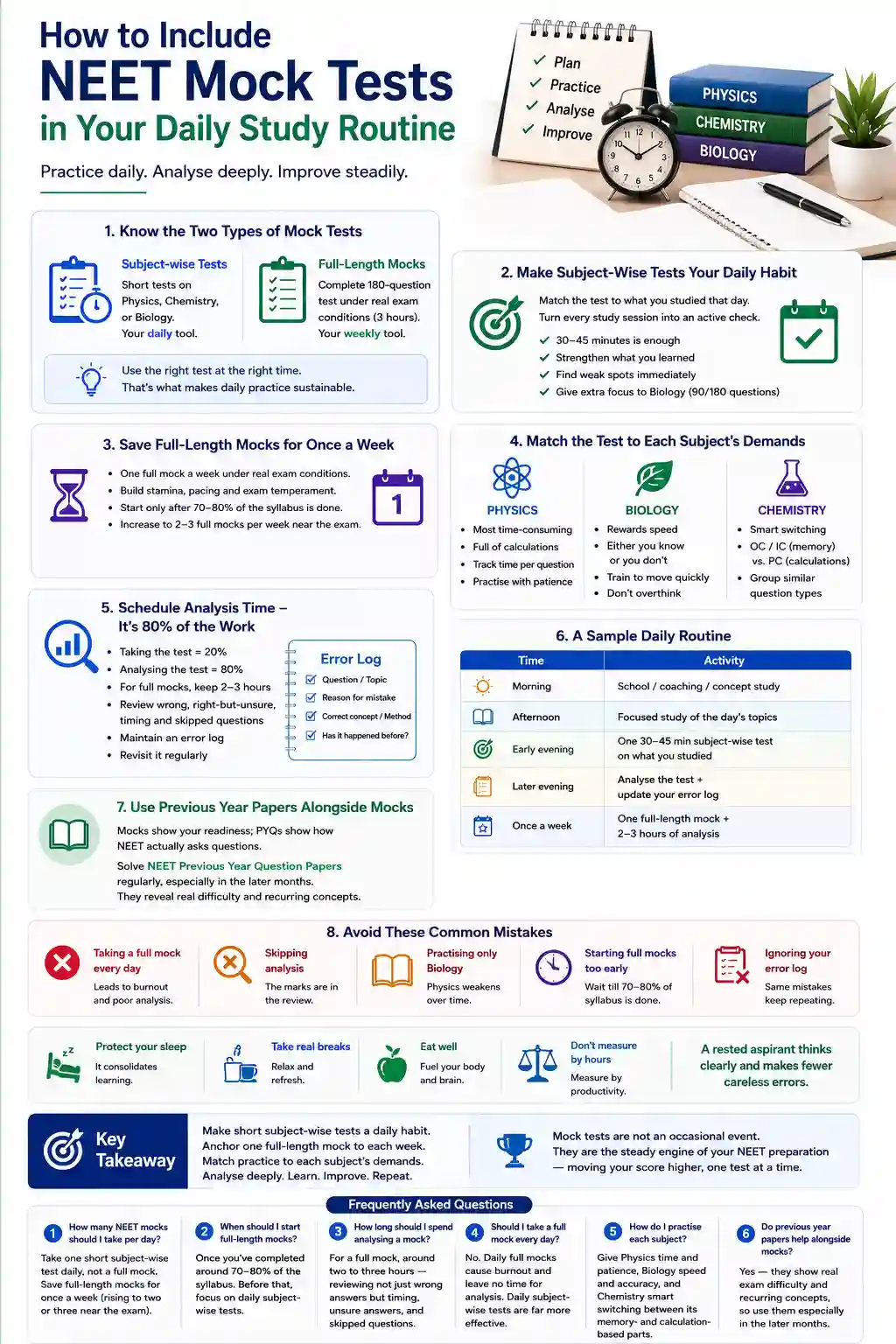
A mistake of many examinees is a failure to recognize that there are two kinds of mock tests and they have to be used differently. First of them are subject-wise tests. They are short and deal with the topic of Physics, Chemistry, or Biology. They constitute a daily test. The second kind of mock test is a full-length mock that consists of 180 questions and 720 marks covering all three topics and lasts for three hours. It is the weekly test.
An efficient NEET Mock Test system offers both kinds of mocks. Thus, it allows setting them up properly. This differentiation is crucial for daily use.
2. Make Subject-Wise Tests Your Everyday Test
A three-hour test is not needed daily. A thirty-to-forty-five minutes test is enough for daily testing. Here is a simple approach. Just set the test according to your studies of the day. You can take the test after completing one chapter of Biology or a unit of Physics and so on. So, you will turn every study session into an opportunity for checking yourself. Besides, knowing what material you have learned is always a good thing. Since Biology takes about 90 out of 180 NEET questions, daily practice of Biology is really helpful.
3. Take Full-Length Mock Tests Once a Week
Taking a full mock daily is a mistake that leads to exhaustion. One full-length mock per week must be taken with real examination conditions (duration of three hours, +4/−1 marking and interruption-free environment). This activity is necessary for developing the stamina for writing a real sample papers test. Moreover, one must not start taking full mocks before he/she has covered 70–80% of the program. Before that stage one should focus on subject-wise tests. But closer to the examination time the number of full-length mocks per week may be raised to two or even three.
4. Tailor Tests to Your Subjects’ Specificity
Every subject in NEET has its specificities. You must adapt your practice to the specificities of each of the subjects.
-
Physics is the most time-consuming subject because of many calculations and problems that require the application of several concepts. It is important to practice at a measured pace and track the time spent on every question.
-
Biology rewards speed and preciseness. Many questions can be solved using knowledge or without. It is necessary to develop speed thinking without overthinking.
-
Chemistry requires a skillful transition between memory and calculation parts of it (Organic and Inorganic and Physical respectively). For practicing this, it is important to group similar questions.
Rotation of tests of different subjects daily will help to keep competence in all of them.
5. Spend Much Time on Analysis—It is 80% of the Work
One aspect that is often overlooked is the fact that test-taking itself gives you only 20% value. Actual value of mocks comes from the analysis of tests. After each test, one has to spend much time analyzing not only the mistakes made but also correct answers when they are not sure about them and the time spent on each question. For a full mock two or three hours must be spent on its analysis. Maintaining the list of mistakes will be helpful. Without analysis, a test gives no educational value.
6. Example of a Daily Schedule
The following example illustrates a possible way of incorporating mocks into the schedule of a NEET aspirant:
-
– Morning: school/coaching/concepts study
-
– Afternoon: studying the topics of the day
-
– Evening: thirty-to-forty-five minutes subject-wise test according to the studied topics of the day
-
– Late evening: test analysis and updating the list of mistakes
-
– Once a week: one full-length mock and two-to-three hours of analysis
One should adjust the schedule to his/her needs. The only thing that is important is taking one short test and analyzing it every day together with anchoring one full-length mock to one day per week.
7. Combining Previous Year Question Papers and Mocks
Mock tests show how ready you are for the exam. Actual papers show how difficult the NEET questions are and what topics are favorite for the NTA. NEET Previous Year Question Papers must be included in the schedule especially at the latter stage of preparation.
Common Mistakes to Avoid
-
– Taking a full mock daily resulting in burnout and poor analysis.
-
– Missing the analysis step. All the insights come from the analysis of the test.
-
– Practicing only Biology and neglecting Physics because of its difficulty.
-
– Starting taking full mocks too early before the syllabus is covered.
-
– Not maintaining the list of mistakes. As a result, mistakes will repeat.
Health
NEET preparation is a long-term process rather than a quick one. A sustainable daily routine is a necessity.
One must get enough sleep since it helps with cognitive consolidation. It is necessary to have breaks, maintain balanced nutrition and not to measure success by the hours of study spent daily. It is easier for a well-rested aspirant to think clearly and not to make careless mistakes since for each wrong answer one gets a minus mark.
Conclusion
NEET mock tests must be incorporated in the daily routine not left on its periphery. One must establish a routine of short subject-wise tests, anchor one full mock per week, tailor practice to the specifics of each of the subjects and consider analysis as the most important part. Having reached this structure, you will transform mocks into a consistent workhorse of NEET preparation gradually improving your performance with every test.
FAQ
1. How many NEET mocks must be taken daily?
One short subject-wise test daily is recommended; full mocks must be taken once a week (increased to two or three closer to the examination).
2. When should full mocks start?
After covering 70–80% of the syllabus. Before that one should practice daily subject-wise tests.
3. How much time should be spent on analysis of the mock?
For a full mock, one should spend two to three hours on its analysis.
4. Should a full mock be taken every day?
No. Daily full mocks lead to burnout and prevent from analysis. The daily subject-wise testing is much more productive.
5. How should one practice each subject?
One should allocate proper time to Physics with careful pace, prioritize Biology with speed and preciseness and use strategic grouping of topics for Chemistry.
6. Are previous year papers complementary to mocks?
Yes. They show real examination difficulties and recurring concepts and should be used especially at the latter stage of preparation.